Why We Need Standardization of Quantum Key Distribution Networks
As quantum computing comes to the fore, many organizations are starting to plan their migration to innovative cryptography solutions. Adopting Quantum Key Distribution (QKD) is a good response to upcoming cyber threats related to communication. It necessitates standardized networks, and here’s why.
What is Quantum Key Distribution?
QKD is a cryptographic protocol aimed at establishing a shared secret between two participants communicating over an insecure channel. This secret is used to generate a common cryptographic key, allowing participants to encrypt their communications using a symmetric encryption algorithm. The security of quantum key exchange is based not on the assumed computational difficulty of certain problems, as is the case for current cryptographic protocols, but on the fundamental principles of quantum physics.
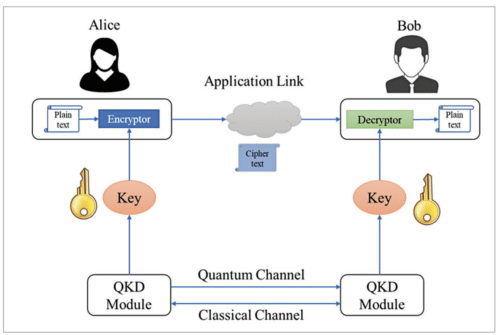
QKD is a cryptographic protocol aimed at establishing a shared secret between two participants communicating over an insecure channel. This secret is used to generate a common cryptographic key, allowing participants to encrypt their communications using a symmetric encryption algorithm.
The security of quantum key exchange is based not on the assumed computational difficulty of certain problems, as is the case for current cryptographic protocols, but on the fundamental principles of quantum physics.
Challenges in Adopting QKD
The adoption of QKD faces several concerns:
Security in Hybrid Implementation: Integrating QKD into an existing classical IT infrastructure may introduce vulnerabilities if the classical components are not properly secured.
Downtime: Unexpected failures may occur in IT systems integrating QKD without proper verification. This can cause service disruptions with serious consequences, especially the loss of client confidence. Imagine a scenario where a client needs to make a financial transaction, but a secure key cannot be established with the vendor’s bank due to equipment failure.
Deployment and Scalability: While QKD has been extensively tested in controlled environments (labs and R&D departments), this does not necessarily make it ready for real-world applications. Some tests of QKD protocols make unrealistic assumptions about the hardware. This is why implementation is a critical moment that requires support.
Interoperability: Many companies fear vendor lock-in and the inability to communicate with others due to incompatibility between different QKD implementations. Imagine if Apple computers couldn’t communicate with Microsoft computers—fortunately, this is not the case due to years of efforts to standardize internet protocols such as TCP/IP.
Standardization Ensures Successful QKD Communications
Security and Interoperability issues are the main reasons why we need standardized norms for safe QKD implementation, ensuring that QKD systems from different vendors can work together seamlessly. This standardization concerns both communication protocols and Application Programming Interfaces (APIs) for a quantum internet.
Fortunately, standards such as ISO 23837 address both quantum and classical components and tackle the security problems faced by QKD systems in operational environments. Additionally, organizations such as ITU and ETSI have published recommendations covering various aspects of QKD, including key management and the standardization of APIs that provide access to system functionalities.
QuRISK by Your Side
At QuRISK, we assist our clients with their QKD implementation and conduct comprehensive security assessments of their IT equipment to ensure compliance with the latest standards and recommendations.
This enables our clients to install QKD systems with peace of mind and confidence in the resilience of their IT systems for the future.
Get in touch to see how we can help: contact@qurisk.fr.