2026, the year of Post-Quantum Cybersecurity Planning
In our last newsletter, we highlighted a critical shift in the quantum cyber threat landscape: governments, industry leaders, and standards bodies are converging on concrete PQC implementation schedules. This edition of QS Lens provides a deep dive into that news to provide clear elements on why 2026 is the definitive turning point year for planning your migration to Post-Quantum Cryptography (PQC).
In this article, we outline the positions of key global stakeholders on the timeline for PQC adoption, then explain the fundamentals required to initiate a PQC transformation, before providing CISOs with a practical to-do list for 2026.
🌎 An international and synchronized global mandate
The shift from education to execution is being driven by concrete international roadmaps:
On 13 January 2026, the G7 Cyber Expert Group (G7 CEG) issued a statement on advancing a coordinated roadmap for the transition to post-quantum cryptography in the financial sector. Their timeline confirms that “Risk Assessment & Planning” must start in 2026. The statement follows an earlier statement that the G7 CEG issued in September 2024 which highlighted the benefits and risks associated with quantum computing.
European Commission (EC): On June 23, 2025, the EC published its PQC coordinated implementation roadmap. It mandates that all Member States develop national PQC transition plans by December 31, 2026. The goals are ambitious: secure critical infrastructure by 2030 and achieve full systemic transition by 2035.
World Economic Forum (WEF): In January 2026, the WEF released updated Quantum-Safe Migration Guidelines, emphasizing that PQC is a unique opportunity to modernize cybersecurity. They advocate for a "defense-in-depth" approach, pairing modern PQC with well established traditional cryptographic layers to ensure resilience during the transition (known as Cryptographic hybridization).
Europol: On January 21, 2026, they published a landmark report providing financial institutions with a structured, risk-based approach to preparing for the PQC transition. As advances in quantum computing are expected to challenge the long-term security of today’s encryption standards, this framework supports early action and long-term planning.
The Quantum Insider officially designated 2026 as the Year of Quantum Security (YQS2026). The launch of the initiative took place on January 12, 2026, in Washington D.C. with high-level support from the FBI, CISA, and NIST. This year-long initiative includes regional summits across the Americas, Europe, and Asia-Pacific focused on PQC deployment.
ANSSI (France):In January 2026, ANSSI considered that the emergence of quantum computers forces industry players to implement algorithms whose maturity is not yet sufficient, and crypto-agility is the most reliable means of ensuring the long-term viability of a system. Therefore, ANSSI issued a guide with recommendations for incorporating crypto-agility into the design of an information system from the start.
⏳ The PQC migration complexity: an IT Transformation, not a patch
At QuRISK, we stress that PQC migration is a massive IT transformation project. It is not a simple software update; it is an organizational overhaul.
🔹The legacy challenge
Legacy systems are the "Achilles' heel" of quantum readiness. Many infrastructures rely on hardcoded cryptographic protocols that are deeply embedded. Migrating these requires complex architectural forensic work to ensure the transition does not break mission-critical dependencies.
🔹A multi-stakeholder journey
This project will impact your entire organization:
💻 Cyber & IT: Infrastructure redesign and implementing crypto-agility.
👩🏼 HR: Upskilling teams and managing specialized talent needs.
✍🏻 Procurement: Updating vendor contracts to ensure all new assets are PQC-ready.
🔹The ROI of early Planning
The "Cost of Urgency" is exponentially higher than the cost of preparation.
✅ Proactive Planning: Allows for phased implementation and integrated budgeting, limiting unnecessary spending.
⚠️ Reactive Management: Forces companies to manage risks in an emergency state, leading to "panic-buying" and technical debt.
The earlier you prepare, the more you mitigate future risks and secure a successful ROI.
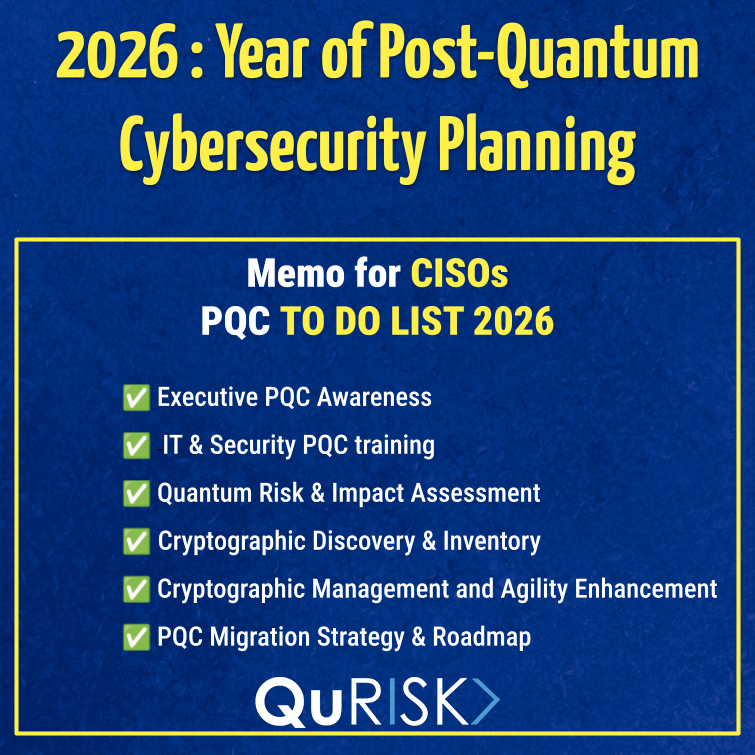
💡 Our 2026 recommended To-Do list for CISOs
To turn this complexity into a structured success, we recommend following this strategic roadmap:
Executive PQC awareness: Securing buy-in at the board level to recognize quantum risk as a business continuity threat.
IT & Security PQC training: Upskilling technical teams to manage new cryptographic standards and hybrid environments.
Quantum Risk & Impact Assessment: Evaluating which data assets are most vulnerable to "Harvest Now, Decrypt Later" attacks.
Cryptographic Discovery & Inventory: Identifying all cryptographic assets (RSA, ECC, etc.) within the infrastructure vulnerable to the quantum threat.
Cryptographic management & Agility enhancement: Implementing tools and processes that allow for the seamless swapping of algorithms.
PQC migration strategy & roadmap: Defining a multi-year transition plan aligned with global regulatory deadlines (2030/2035).
Here is a memo you can download (right-click):
🍒🍒🍒 BONUS : PQC White Paper
In December, we collaborated with the Forum des compétences (French association for CISOs in financial sector) to publish a white paper (in French 🇫🇷), presented during a seminar held by Banque de France :
"Quantique & Cybersécurité : Risques et Opportunités pour le secteur financier"
This guide provides a pragmatic framework for financial services companies to navigate the PQC transition.
⚡️QS LENS : TURNING QUANTUM & CYBERSECURITY NEWS INTO KNOWLEDGE⚡️
QS Lens is a series proposed by The Quantum-Safe Sentinel: concise, knowledge-driven articles that dive into recent quantum cybersecurity developments.
🌟 If you appreciate our work for the community, please like and share our publications, follow our page, and promote it to colleagues who may benefit from these insights.
☎️ If you have any suggestions or comments about our publications, or if you would like to discuss these important topics with one of our experts, feel free to book a meeting at www.qurisk.fr or to contact us (contact@qurisk.fr).
📡 Stay tuned for more to come. Stay healthy, and quantum-safe to you all.
🦉 This bulletin is powered by oQo, QuRISK’s Quantum Virtual Advisor: an AI-driven LLM designed to augment professionals on quantum technology–related themes, including securing adoption, risk management, and cybersecurity. To learn more about oQo, please visit www.myoqo.ai.
It is published by QuRISK - Quantum Risk Advisory, a French firm specialized in Quantum Risk & Cybersecurity.